Trees that fail in hurricanes on the Grand Strand
The storms that hit the Strand are mostly rain events before they're wind events, and the trees that fall are mostly predictable: the wrong species, too much weight over the roof, dead wood, and roots in sand that was already full of water.
The storm log
- Hugo — September 22, 1989Category 4 landfall at Sullivan's Island at 135–140 mph; a 13-foot surge into Garden City and Surfside, 43 percent of Garden City's beachfront destroyed, Pawleys Island cut in two, and more than a billion board-feet of timber felled in the Francis Marion.
- Matthew — October 8, 2016A 74 mph gust at Myrtle Beach International, 70 at North Myrtle Beach, an 85 mph EF0 tornado 1.5 miles through North Myrtle Beach damaging trees, and half the Surfside pier gone.
- Florence — September 14–16, 2018The Strand's strongest measured gust, 77 mph at Cherry Grove; 61 at the airport, 60 at North Myrtle Beach, 59 at Murrells Inlet. 23.63 inches of rain at Loris — the South Carolina tropical record. EF0 tornadoes two miles north of Myrtle Beach (broken pine tops) and near Goretown. About 80,000 Grand Strand customers without power; the Waccamaw at Conway set its record at 21.16 feet twelve days later.
- Isaias — August 3–4, 2020Landfall just up the coast at Ocean Isle; 70 mph at Crescent Beach, 53 at Myrtle Beach and North Myrtle Beach.
- Ian — September 30, 2022Second landfall at Georgetown; 70,000 Santee Cooper customers out, 20 poles and 32 transformers replaced, Litchfield and Murrells Inlet hit hardest; Horry Electric 8,709 out.
- Helene — September 2024Never came near the coast, but Clemson estimates it took one to four percent of South Carolina's whole tree canopy inland in a day — water oaks, pecans, Bradford pears, maples and pines — because saturated soils let the wind uproot even well-rooted trees.
- Chantal — July 6, 2025Landfall at Litchfield Beach around 4 a.m. at 60 mph; 56 at Springmaid Pier; 4.86 inches at Longs.
- Also: an F2 tornado on July 6, 2001 that ran four miles up the beach from the Pavilion and injured 39; five inches of snow in January 2025, the most since 1989; and South Carolina's 13th-place ranking for lightning density.
The rankings
The University of Florida's wind-resistance rankings, built from post-hurricane surveys and used by arborists across the Southeast, sort our trees cleanly. Highest: live oak, sand live oak, sabal palmetto, Southern magnolia, bald cypress, crape myrtle, American holly, dogwood. Medium-high: sweetgum, river birch. Medium-low: red maple, hackberry, wax myrtle, redbay, sycamore, white and willow oak, slash, longleaf and loblolly pine. Lowest: laurel oak, water oak, pecan, Bradford pear, Chinese tallow, Southern red cedar, tulip poplar, Leyland cypress. Survival rates through Erin, Opal and Ivan: live oak 96, 95 and 91 percent; sand live oak 96, 96 and 99; sabal palmetto 97, 100 and 80. Clemson rates Eastern red cedar high, which conflicts with Florida's low rating for Southern red cedar; we treat cedars as a middle case and look at the individual tree. Clemson also ranks longleaf as the most wind- and drought-tolerant of our pines. And Clemson's Helene assessment names the losers by name: water oak, pecan, Bradford pear, maples and pines.
Why healthy trees fall here
Because the ground gives up before the tree does. Behind the dunes, the Strand's soils are Leon and Lynn Haven sands with a spodic hardpan within 30 inches and a water table six to eighteen inches down for months of the year; inland, 410 Carolina bays of peat; at Conway, river clay. A hurricane here drops its rain first — Florence's 23 inches, Chantal's five — and by the time the wind arrives a pine with a perfectly sound root system is standing in soup. It goes over whole, root plate and all, toward whatever is heaviest below it. Clemson says the same about Helene inland: saturated soils let wind uproot well-rooted trees. So the three things to look at on the Strand are species (above), weight and lean (a long limb over the roof or a trunk already leaning toward the house is what fails when the roots are floating), and how your lot drains. Dead wood is the fourth, and it's the easy one.
The May checklist
- Rank the trees. A dead or beetle-hit pine over the house is first. A laurel or water oak over 50 years old over anything is second. A Bradford pear or Chinese tallow near a structure (they split at the crotch) is third. Any tree with a new lean after the last storm, fourth. A healthy live oak or palmetto is the tree you want.
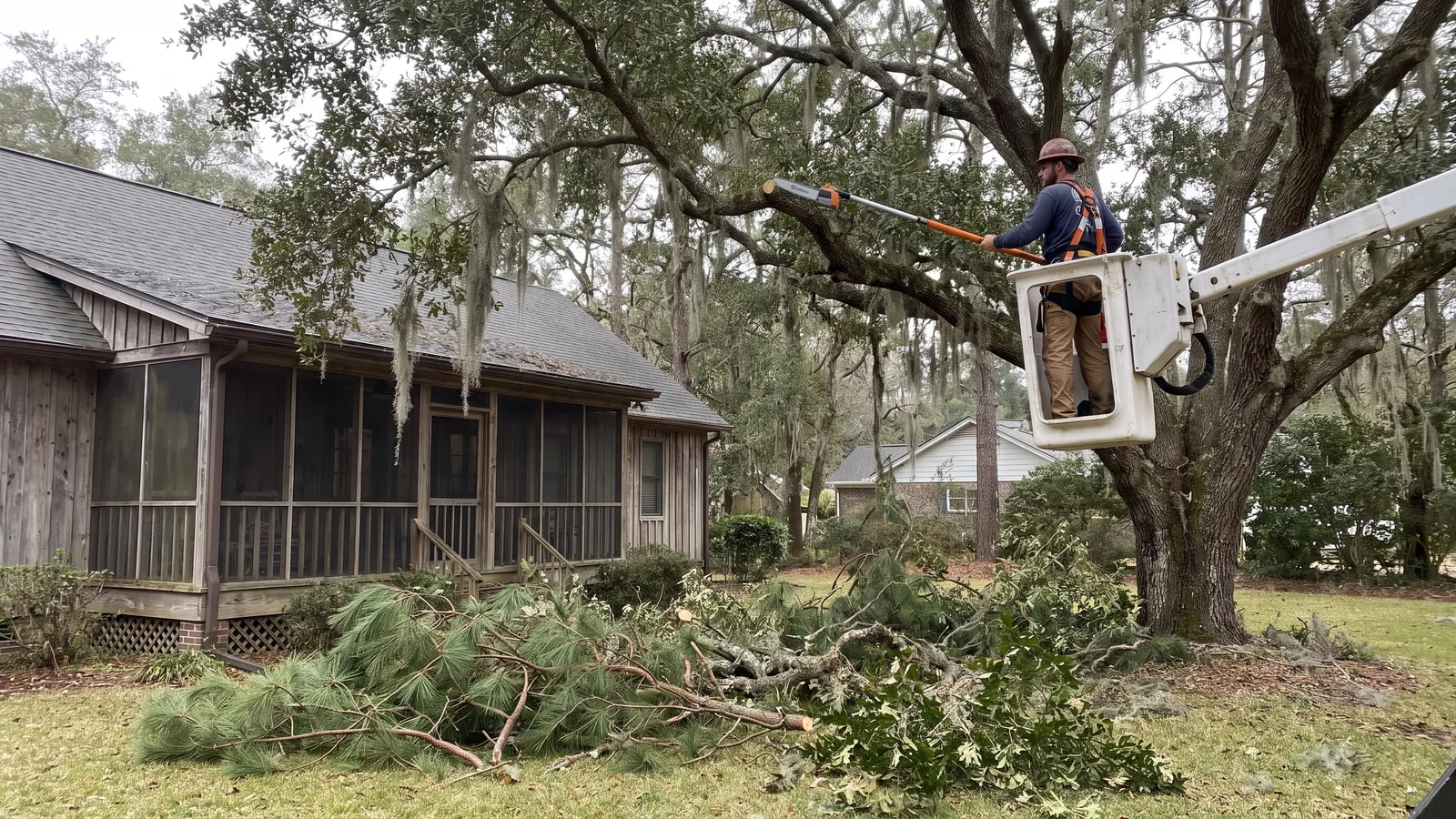
- Thin and reduce, don't top. Crown thinning lets wind through; weight reduction shortens the limbs over the roof back to laterals. Topping makes failure more likely and is illegal on protected trees in Myrtle Beach, Conway, Surfside and Georgetown County.
- Deadwood the big oaks. The limbs that come down in the first 40 mph gust, removed on your schedule.
- Leave the palmettos full. Dead fronds and seed stalks only. A hurricane-cut palm snaps; a full crown sheds wind.
- Schedule removals now. Cranes and permit offices are available in May; in October everyone from Little River to Pawleys is calling at once and the towns are processing storm waivers.
- Know your utility. Santee Cooper trims the primary lines and will disconnect your service line free with a day's notice; Horry Electric's right-of-way is 30 feet. Nobody trims your trees for you.
Common questions
Which is more dangerous, a pine or an oak?
A dead pine over the house is the most dangerous tree on the Strand; a healthy live oak is the safest. A 60-year-old laurel oak is somewhere in between and closer to the pine. Species and condition together, not one or the other.
Should I take down all the pines around my house?
No — a healthy longleaf is a reasonable tree. Take the dead ones, the beetle-hit ones, the ones with a lean, and the ones close enough to the house that a fall lands on the roof. Thin the rest.
Does the water table really matter that much?
It's the whole story on the coast. Florence's trees fell in saturated sand, not because they were rotten. A lot that stands in water after rain is a lot where lean and weight matter more than species.
Can I do hurricane prep in August?
You can, and it's better than nothing — but the crane and the crew are booked, and the permit office is slow. March to May is the window.
Related: Hurricane tree prep · Emergency tree service · Storm cleanup · Pine beetles